
The August 6 Executive Orders: What International Intended Parents Need to Know
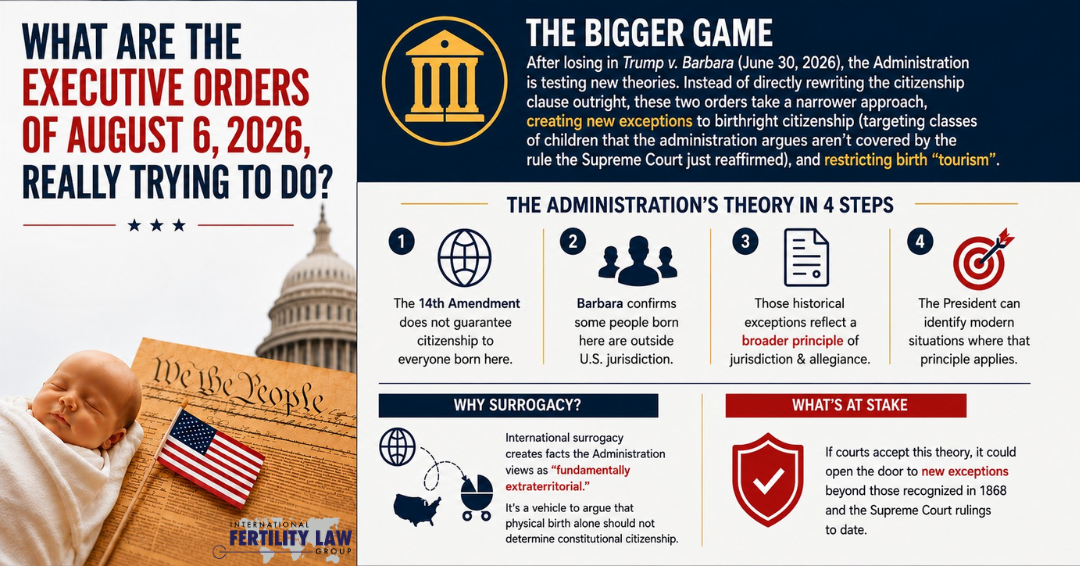
IFLG has been closely following the evolving debate over birthright citizenship and its implications for international surrogacy families since President Trump first sought to restrict birthright citizenship in 2025. We previously examined the Administration’s earlier executive order and the Supreme Court’s subsequent decision in Trump v. Barbara. The latest development brings the issue much closer to the assisted reproduction community.
On August 6, President Trump signed two new executive orders on birthright citizenship and birth tourism. One of them, Continuing to Protect the Meaning and Value of American Citizenship, addresses surrogacy directly, and it is the focus of this article. It does not invalidate surrogacy agreements. It does not prevent the issuance of parentage orders or birth certificates. It does, however, create uncertainty about whether the President can create exceptions to birthright citizenship and whether federal agencies can be instructed not to issue documents (such as passports and social security cards) proving U.S. citizenship for some children, including those born through U.S. surrogacy, when neither intended parent is a U.S. citizen. The second order, Ending Birth Tourism, concerns visas and entry into the United States, and is discussed later in this article.
What changes, and what does not
Before anything else, it is worth being clear about what the citizenship order does not do. Nothing in its text requires anyone to stop or delay a surrogacy journey. As noted at the outset, it does not change state surrogacy law. It does not void a gestational carrier agreement. It does not, on its face, prevent a state court from issuing a parentage judgment or a state vital records office from issuing a birth certificate.
The immediate issue is federal. It concerns how agencies such as the Department of State will treat U.S. citizenship and federal documentation, including a U.S. passport, in circumstances the executive order purports to cover. That distinction is worth holding onto throughout. A U.S. passport is evidence of citizenship rather than the source of it. Citizenship arises at birth under the Constitution and federal statute; the passport documents that citizenship exists. The executive order operates on what federal agencies issue and recognize, not on the constitutional question itself.
The key legal question is this: can the President create a new exception to birthright citizenship for certain children born through surrogacy and can the President issue an executive order instructing a branch of the government to violate the law requiring the issuance of passports to U.S. citizens? Only five weeks ago, in Trump v. Barbara, the Supreme Court rejected the Administration’s earlier effort to limit birthright citizenship based on the immigration status of a child’s parents. The August 6 executive order does not simply repeat that argument. Instead, it advances a narrower theory by arguing that certain situations, including some commercial surrogacy arrangements, should be treated as exceptions to the ordinary rule that a child born in the United States and subject to U.S. jurisdiction will be issued citizenship documents.
Two separate obstacles stand in the way of that theory, and it helps to keep them apart. First, can a new exception to birthright citizenship be recognized at all? Second, who has the authority to create one? Congress has already written the citizenship rule into federal law, so any attempt by the President to add an exception raises a separate statutory question. Both issues are examined below.
If at least one intended parent is a U.S. citizen, the surrogacy provision does not apply by its terms. One point deserves particular attention here. The order says citizen, not lawful permanent resident. Unlike the 2025 executive order, it does not place a family outside this provision merely because one parent holds a green card. If neither intended parent is a U.S. citizen, the analysis becomes more important, particularly for families with a delivery approaching.
What exactly changed on August 6?
The new citizenship order directs federal agencies not to issue or accept documents recognizing U.S. citizenship for certain children born in the United States when neither parent is a U.S. citizen and one of several circumstances identified in the order applies.
For the assisted-reproduction community, the critical language appears in Section 2(c)(ii). It refers to a parent who has engaged in a commercial transaction “to purchase or access birthright citizenship for the person” including “when the parent(s) engage in a commercial transaction with a surrogate present in the United States, or a territory of the United States, to give birth”.
That is new. The federal government has previously regulated “birth tourism,” including through visa rules aimed at people who travel to the United States for the primary purpose of giving birth. The August 6 order goes further by expressly naming surrogacy in the citizenship context, even though in a typical U.S. gestational-surrogacy arrangement the person carrying the pregnancy already lives in the United States.
What remains unclear is how federal agencies will apply the new surrogacy provision in practice. Among the questions the order does not answer:
- How will agencies identify which births involved surrogacy, and what will applicants be asked to disclose?
- Must a primary or any purpose or intent to obtain citizenship be shown, or is compensation alone enough?
- What is a “commercial transaction with a surrogate”? The provision is written around the arrangement with the carrier rather than the overall cost of a journey, and it says nothing about uncompensated arrangements or those limited to reimbursement of expenses.
- How will one agency’s determination affect another? A passport decision, a Social Security record, and a later immigration matter are handled by different offices.
Timing is also unresolved. The 2025 executive order applied only to children born more than thirty days after it was signed. The August 6 executive order contains no equivalent provision and no stated effective date, although Section 3(b) directs the heads of all executive departments and agencies to issue public guidance within 30 days of the date of the executive order regarding its implementation with respect to their operations and activities. That leaves open many questions, including how the order is meant to apply to pregnancies already underway and to children already born whose citizenship documentation is still pending. What the order does not do is direct agencies to revoke passports or citizenship records that have already been issued. The executive order also does not direct these agencies to coordinate their guidance, leaving significant room for inconsistent implementation.
It is also worth knowing where official guidance stands today. The State Department’s Foreign Affairs Manual (“FAM”) currently provides, at 8 FAM 304.3-1(b), that children born in the United States acquire U.S. citizenship at birth regardless of the use of assisted reproductive technology or surrogacy. The guidance memo from the State Department may likely revisit this provision and others within the FAM.
Why is this happening now?
The answer begins with the Supreme Court’s June 30 decision in Trump v. Barbara, 609 U.S. ____, 146 S. Ct. 2438 (2026). In 2025, the Administration attempted to restrict birthright citizenship based largely on the immigration status of a child’s parents. The Supreme Court rejected that approach by a vote of six to three.
Five Justices concluded that the Constitution itself protected the citizenship of the children covered by the 2025 executive order. They explained that the phrase “subject to the jurisdiction” concerns a person’s relationship to the sovereign authority and laws of the United States, not the immigration status of the child’s parents.
The Court made that point in a way that is easy to follow. It observed that the words appearing most often in the 2025 executive order, “mother,” “father,” “lawful,” and “temporary,” appear nowhere in the Citizenship Clause of the Fourteenth Amendment. “For a simple reason: they did not matter.”
Justice Kavanaugh agreed that the 2025 order could not stand, but for a different reason. Congress has already enacted a federal citizenship law, 8 U.S.C. § 1401(a), that grants citizenship to people born in the United States and subject to its jurisdiction. In his view, even if additional exceptions might theoretically be possible, the President could not create them on his own while that federal law remained unchanged.
The Administration is therefore not simply asking federal agencies to disregard Barbara. It is pursuing a different legal theory. Historically, the Supreme Court has recognized a small number of narrow exceptions to birthright citizenship, including children born to foreign diplomats, because those children are not subject to ordinary U.S. jurisdiction in the same way as most people born on U.S. soil. The August 6 executive order attempts to add new modern categories to that framework, including certain commercial surrogacy arrangements. The Administration may view that path as available in part because Justice Kavanaugh did not agree that the historical exceptions must remain a permanently closed list.
There is an important limit on that theory, and it is easy to miss. Justice Kavanaugh was writing separately, for himself. Kavanaugh understood the five-Justice majority as treating the historically recognized exceptions as a closed set, and he expressly disagreed with that approach. If that understanding of the majority is correct, recognizing commercial surrogacy as a new exception would face an additional constitutional obstacle.
That is why the legal question has changed. The dispute is no longer primarily about a parent’s immigration status defeating a child’s birthright citizenship. It is now about treating commercial surrogacy as a new exception to the Fourteenth Amendment’s ordinary rule, and about the President’s authority to create that exception without Congress.
How does the law apply to surrogacy?
The Fourteenth Amendment provides that persons born in the United States and subject to its jurisdiction are citizens at birth. Congress uses essentially the same language in 8 U.S.C. § 1401(a). As discussed above, the Supreme Court has historically recognized only narrow exceptions to that rule, including the previously noted exception for children born to foreign diplomats who are not subject to ordinary U.S. jurisdiction.
That is where the surrogacy provision becomes difficult to fit within the historical framework. In a typical U.S. gestational-surrogacy arrangement, the gestational carrier lives in the United States and is fully subject to U.S. law. Her pregnancy is managed through U.S. medical providers. The surrogacy agreement is governed by state law. State courts may enter orders determining the child’s legal parents. The child is born in a U.S. hospital and, from the moment of birth, is protected by and subject to U.S. law. Nothing about compensating the gestational carrier, by itself, removes either the carrier or the child from the sovereign authority of the United States.
That leads to the central constitutional question, which can be stated simply.
The Fourteenth Amendment asks where a child was born and whether the child is subject to U.S. law. The surrogacy provision asks something different. It focuses on why the parents arranged the birth (was it to acquire U.S. citizenship?) and whether money changed hands.
Those are not the same questions. A court will have to decide if the second can change the answer to the first.
The August 6 executive order also introduces a vocabulary of its own: commercial, surrogate, transaction. None of those words appear in the Citizenship Clause either. That comparison is ours rather than the Court’s, but it follows from what the Court said about where citizenship comes from.
The Supreme Court did not address surrogacy in Barbara, so that precise question remains open. But the Court’s reasoning creates a significant obstacle for the Government. If the child is born in the United States and is fully subject to American law, the Government would need to explain why the commercial nature or purpose of the parents’ surrogacy arrangement changes the child’s constitutional relationship to the United States.
Even if new exceptions were possible, could the President create one without Congress?
Suppose for the sake of argument, that the Administration is right and that new exceptions to birthright citizenship can be recognized. A second question would still remain, and it is the one most families find easiest to follow: who gets to create them?
The answer has less to do with surrogacy than with how the federal government is arranged. Citizenship at birth is not governed by the Constitution alone. Congress has legislated on it, in 8 U.S.C. § 1401(a), which grants citizenship to a person born in the United States and subject to its jurisdiction. Where Congress has enacted a rule, the President’s role is to carry that rule out, not to rewrite it. An executive order that conflicts with a federal statute does not displace the statute; the statute prevails. Under Justice Kavanaugh’s reasoning in Barbara, creating such an exception would require Congress to change the existing federal citizenship statute rather than the President attempting to do so through executive order.
As discussed, Justice Kavanaugh left open the possibility that additional exceptions to birthright citizenship could exist, but he concluded that the President could not create them without congressional action. Congress has not amended Section 1401(a).
That leaves an important point of agreement. The majority found that the Constitution itself protected the children covered by the 2025 executive order, while Kavanaugh reached the same practical result through the statute. The reasoning differs, but under either approach, the Executive Branch cannot create a new exception on its own.
For the August 6 executive order, that means the Administration would need to win twice over. It would have to persuade a court both that (A) new exceptions may be recognized, which the majority appears to reject, and (B) that the President may create these himself, which Justice Kavanaugh rejected. Neither of the two routes taken by the six Justices who struck down the 2025 executive order provide a pathway to success for the Administration.
Does a family’s intent matter?
One of the most important unanswered questions is the scope of the order: does it reach every compensated U.S. surrogacy arrangement involving two non-U.S.-citizen intended parents, or only arrangements undertaken for the purpose of obtaining U.S. citizenship?
The uncertainty comes from the wording of Section 2(c). It begins by describing a commercial transaction undertaken “to purchase or access birthright citizenship for the person” and then identifies surrogacy as one circumstance included within that category. One natural reading is that the purpose requirement applies to surrogacy as well. Under that interpretation, compensation alone would not automatically bring an arrangement within the order; the Government would also need to treat obtaining U.S. citizenship as a purpose of the transaction.
Another reading is broader. Federal agencies could treat the surrogacy subparagraph as an independent category that applies whenever two non-citizen intended parents use compensated surrogacy in the United States, regardless of why they chose the United States. The agency guidance expected in early September may tell us which interpretation the Administration intends to use.
If intent does matter, several additional questions follow. Whose intent counts? Must citizenship be the primary purpose, a substantial purpose, or merely one consideration? Who bears the burden of proving that purpose? And what evidence will agencies consider? The order does not answer those questions.
This distinction is especially important because international families choose the United States for many reasons unrelated to citizenship: established surrogacy laws, enforceable agreements, experienced fertility clinics and agencies, continuity of medical care, and reliable procedures for establishing legal parentage. A family may know that a child born in the United States ordinarily acquires U.S. citizenship without citizenship being the reason it chose U.S. surrogacy. Awareness of a legal consequence is not necessarily the same as entering an arrangement for the purpose of obtaining that consequence. How federal agencies will draw that line remains unresolved.
Surrogacy is not the same as birth tourism
The second executive order signed on August 6, Ending Birth Tourism, addresses immigration and visa consequences for people who enter the United States for the purpose of giving birth, or who facilitate another foreign national’s entry for that purpose.
That is different from the usual international gestational-surrogacy model. In a U.S. surrogacy case, the pregnant person is generally a U.S.-based gestational carrier. The intended parents may travel to the United States near delivery to meet and care for their child; they are not themselves entering the country to give birth.
Nothing in the birth-tourism order expressly says that intended parents traveling for the birth of a child carried by a U.S.-based surrogate are “birth tourists.” Until federal guidance provides more detail, that distinction should not be blurred. International intended parents should, however, review their own visa and travel circumstances with counsel before traveling.
What happens legally from here?
The next stage is likely to unfold on two tracks: federal agencies will prepare implementation guidance, while intended parents stuck in the crosshairs apply for national interest exceptions and challengers ask courts to block all or part of the order.
The first important court ruling may come well before any final decision from the Supreme Court. A person or organization challenging the order could ask a federal court to temporarily stop the Government from enforcing all or a portion of the executive order (including or specifically calling out the surrogacy provision) while the lawsuit proceeds. Courts can do that through a temporary restraining order or a preliminary injunction. For families with pregnancies already underway, such an order could be extremely important because it may determine if federal agencies can apply the new rule to children born while the litigation is pending. If a court grants relief, families will still need to understand its scope: does it apply nationwide, to a defined group of families, or only to the particular plaintiffs? Does it specifically cover surrogacy? Has a higher court paused or stayed the ruling on appeal?
The August 6 executive order contains a severability clause. In practical terms, that means a court could potentially block the surrogacy provision without invalidating every other part of the order. A surrogacy-specific ruling is therefore possible.
Ultimately, the constitutional and statutory questions could return to the Supreme Court. But that process may take time. For families with current pregnancies, preliminary court orders and agency guidance may be more important in the immediate term than the eventual final ruling. Pre-emptively applying for a national interest exception on a case-by-case (family-by-family) basis may also be another avenue clearing the way to entry and/or the issuance of a passport.
The Practical Risk: Citizenship Documentation and Travel
For families with a delivery approaching, this is usually the question underneath all the others: could a child be born with a valid state parentage judgment and birth certificate but face a delay or a refusal at the passport stage?
If U.S. passport issuance is delayed or unavailable, counsel can assess the child’s eligibility for a national interest exception and/or citizenship and travel documentation through an intended parent’s home country. Valid alternative travel documentation may provide a route home. The answer in any particular case depends on the child’s nationality rights, the home country’s recognition of parentage, applicable entry requirements, and carrier documentation rules.
The genuine difficulty sits on the home-country side, and it is where circumstances vary the most. Before a consulate issues anything, it generally has to be satisfied that the intended parents are the child’s legal parents. In some jurisdictions, including several European countries, recognition of parentage established through surrogacy abroad can require additional legal or administrative steps and may be document-intensive. In other countries the process is comparatively direct. This is precisely why the answer cannot be generalized, and why it is worth working through the specific family’s situation well before delivery rather than after a passport problem appears.
What should international intended parents do now?
The most useful response at this stage is careful planning based on each family’s circumstances. Families should not assume that the order will ultimately be upheld or stricken, but they also should not wait until after delivery to understand their documentation and travel options.
1. Start with timing
A family expecting a child in a few weeks faces a different practical question from intended parents who are only beginning a surrogacy journey. Families with near-term deliveries should speak with their legal team now about the status of the order, anticipated agency guidance, passport timing, and any litigation that may affect their delivery window.
2. Separate parentage, citizenship, and travel documents
These are related but distinct issues. A state parentage judgment determines who the child’s legal parents are under state law. A birth certificate records the birth and parentage information required by the state. U.S. citizenship and a U.S. passport involve federal law and federal agencies. A dispute over federal citizenship recognition does not, by itself, invalidate a surrogacy agreement or parentage judgment.
3. Map the home-country route early
Determine if their child may acquire citizenship through the intended parents under the law of their home country, what that country requires in order to recognize the parentage judgment and birth record, and what travel document it can issue and how quickly. Where the recognition step is difficult, it is the part that takes time, and it is far easier to begin before the birth than after.
4. Preserve the record that already exists
Because intent may become relevant, families should preserve the ordinary, contemporaneous records of their journey, for example clinic history, embryo location, agency selection, legal advice, and other records showing why the United States was chosen. This is about preserving an existing record, not creating a new explanation after the fact.
5. Review the intended parents’ own travel
The citizenship order and the separate birth-tourism order raise different issues. Intended parents approaching delivery should confirm that their visa status and travel plans have been reviewed with appropriate counsel. One principle applies regardless of what the guidance eventually says: every statement made on a visa application, at a border, or to a consular officer should be accurate and complete. Questions about a surrogacy arrangement should be answered honestly and without embellishment. If a question is difficult, that is a reason to speak with counsel in advance, not a reason to improvise an answer.
What should families focus on in the coming weeks?
For international intended parents, the amount of commentary around birthright citizenship can quickly become overwhelming. Most families do not need to follow every political statement or legal theory. They should focus on four developments:
- Federal agency guidance: how the Government says it intends to apply the surrogacy provision in practice.
- Court orders: any ruling that blocks the surrogacy provision, the families protected by that ruling, and its status on appeal.
- Their own delivery timeline: the law may look different for a birth in several weeks than for a birth many months from now.
- Their individual facts: intended-parent citizenship, travel status, state of birth, parentage process, and available home-country citizenship and travel options.
The constitutional issue is serious, but the August 6 order is not the final word. It is a new Executive Branch position that must now be implemented by federal agencies and tested against, among other things, the Fourteenth Amendment, federal citizenship law, and the Supreme Court’s recent decision in Barbara.
IFLG is continuing to monitor federal guidance, litigation, and any court orders affecting implementation. If you have a U.S. surrogacy pregnancy underway, and particularly if delivery is approaching, speak with your legal team now so that your parentage, citizenship-documentation, travel, and home-country plans can be reviewed together. If you are unsure whether or how these executive orders may apply to you, please understand that each case has its own unique circumstances, and legal advice should be tailored to your unique circumstances.