
Scotus Upholds Birthright Citizenship and Strikes Down Trump’s Executive Order
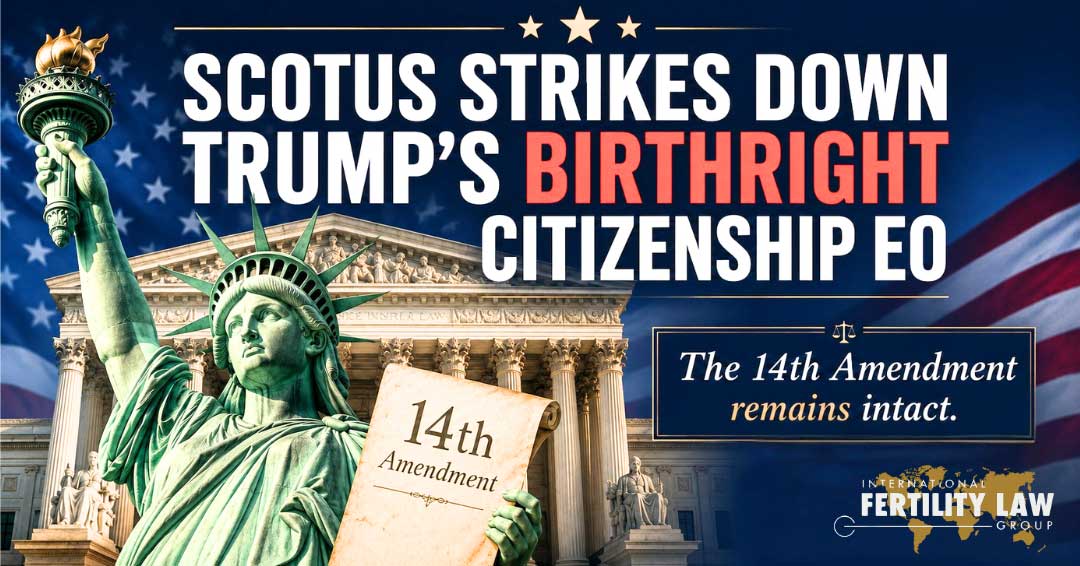
The Supreme Court of the United States has issued its decision in Trump v. Barbara, and the result is what this firm anticipated from the very day Executive Order 14160 was signed. Birthright citizenship, guaranteed by the Fourteenth Amendment to the United States Constitution, remains intact. Trump’s executive order is an unconstitutional violation of the 14th Amendment. An executive order is not a mechanism for rewriting the Constitution, and the Court has made that clear in terms that settle the matter for the present administration.
The birthright citizenship clause of the 14th Amendment states, without exception, that “all persons born or naturalized in the United States, and subject to the jurisdiction thereof, are citizens of the United States.” Congress approved that text in 1868 precisely to foreclose debate about whether certain categories of persons born on American soil were entitled to full citizenship.
The Court resolved any doubt about that meaning in 1898, in United States v. Wong Kim Ark, holding that a man born in San Francisco to Chinese parents was a United States citizen by virtue of having been born on American soil, regardless of his parents’ immigration status. That decision has governed American law for 128 years.
In Barbara, the Trump administration rested its position on the phrase “subject to the jurisdiction thereof.” Its argument was that the phrase should be interpreted more narrowly. Under that reading, children born in the United States to certain persons without permanent immigration status would not automatically acquire United States citizenship.
The problem with that argument is that it does not align with the Fourteenth Amendment’s historical meaning. When the Amendment was ratified in 1868, the phrase “subject to the jurisdiction thereof” had a specific and limited scope. It excluded, for example, the children of foreign diplomats, because their parents enjoyed sovereign immunity and were not fully subject to American civil and criminal jurisdiction. It also excluded, at that historical moment, children born on American soil to members of Native American tribes not yet subject to federal law. But it did not exclude, nor was it understood to exclude, the children of immigrants, whatever the documentary situation of their parents.
When Congress wishes to condition a right on a person’s immigration status, it knows how to say so expressly. The birthright citizenship clause contains no such condition. Accepting the administration’s interpretation would therefore have required the Court to add to the constitutional text a restriction its drafters did not include. That problem alone was likely fatal to the executive order. But it is not the only one.
A President cannot reinterpret the Constitution by executive order. The Constitution is not an ordinary statute. Its guarantees do not bend to the policy preferences of a given administration. When an executive order purports to restrict a constitutional right by redefining the scope of the Constitution itself, it exceeds the constitutional authority of the Executive Branch. Article II of the Constitution grants the President executive power and requires faithful execution of the laws. It does not grant authority to modify the Constitution.
The constitutional amendment process exists precisely because the Founders understood that fundamental law must be changed through broad democratic consensus, not through unilateral executive action. A constitutional amendment requires approval by two-thirds of both chambers of Congress and ratification by three-fourths of the states, that is, thirty-eight of the fifty states. The process is deliberately demanding. It is demanding because constitutional rights deserve a level of democratic commitment that no administration can claim on its own.
What the Supreme Court has confirmed today is exactly what was apparent from the moment Executive Order 14160 was signed. The Fourteenth Amendment means what it says. The precedent established in Wong Kim Ark remains settled law. No directive from the executive branch can alter either of those facts. That the Court had to say so explicitly is unfortunate. That it did so is not a surprise.