
In 1991, the legal framework governing the disposition of frozen embryos was effectively tabula rasa. As a law student, I found myself grappling with a question that science had posed but the law had not yet answered: What happens to frozen embryos when the couple who created them separates?
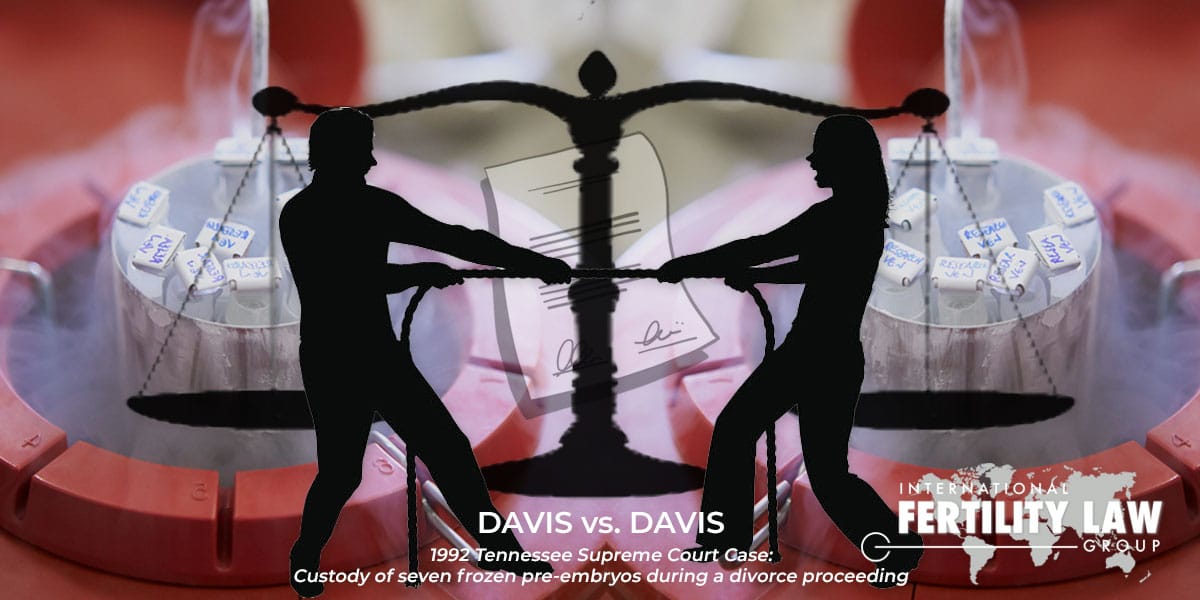
At the time, the nation’s eyes were fixed on a seminal case winding its way through the Tennessee courts: Davis v. Davis. The dispute involved Junior and Mary Sue Davis, a divorcing couple engaged in a bitter tug-of-war over seven cryopreserved embryos. Mary Sue sought custody of the embryos to donate them to a childless couple; Junior vehemently objected, arguing that he should not be forced into genetic fatherhood against his will. The case forced the legal system to confront an ontological crisis: Were these microscopic clusters of cells property to be divided, persons to be protected, or something else entirely? In a paper titled “Frozen Embryos – What To Do?”, I analyzed this collision of human hope and constitutional privacy, proposing a framework grounded in contract law, an approach that prioritized the parties’ original intent while balancing their respective rights.
On June 1, 1992, the Tennessee Supreme Court issued a ruling that reflected that same reasoning. The court ultimately sided with Junior, establishing a legal hierarchy that would become the bedrock of American embryo disposition law: first, honor the prior agreements of the parties; second, if no agreement exists, balance the parties’ interests; and finally, recognize that the right to avoid procreation generally outweighs the right to procreate.
The Fracturing of a Legal Standard
For years, Davis served as the North Star for courts nationwide: reproductive liberty is paramount and the state should avoid forcing parenthood against an individual’s will. However, as the use of Assisted Reproductive Technology (ART) exploded, the singularity of Davis gave way to a patchwork of judicial interpretation.
While many jurisdictions adhered to the Davis framework, others diverged, creating a fragmented legal map that persists today. Currently, state courts generally employ one of three approaches to resolving these disputes:
- The Contractual Approach: Strictly enforcing prior written agreements, treating the directives signed at the clinic as binding contracts.
- The Balancing Test: Weighing the relative interests of each party at the time of the dispute, often favoring the party wishing to avoid parenthood.
- The Contemporaneous Consent Model: A minority view requiring mutual agreement at the precise moment of disposition, effectively granting either party a veto power regardless of prior contracts.
This lack of uniformity is no longer merely an academic concern. With the dramatic rise in IVF cycles and the increasing mobility of intended parents, families may find that their reproductive rights shift radically simply by crossing state lines. The uncertainty leaves former partners in a costly, emotional limbo.
From Case Law to Statute: The Push for Uniformity
Recognizing that judicial improvisation was insufficient to manage the complexities of modern family formation, the legal community mobilized. In 2018, I chaired a subcommittee within the American Bar Association’s Family Law Section, specifically charged with moving beyond the unpredictability of case law to draft model legislation.
Our objective was to move beyond the reactive nature of case law and codify a standard that is ethically sound, legally robust, and nationally scalable. Drawing on three decades of judicial trends, we recognized that the most stable rulings were those that treated the embryo disposition agreement not as a mere administrative formality, but as a binding directive. In doing so, the subcommittee returned to the same foundations I argued for in 1991: that written intent should control the allocation of rights, that frozen embryos should not be treated as divisible marital property, and that in any conflict of interests, the right to avoid procreation must remain paramount.
We also incorporated crucial psychological considerations and clinic best practices, acknowledging that while human emotions are fluid, the legal status of genetic material cannot be. To that end, we sought to create a statutory framework that provides predictability for providers and protection for patients. The resulting legislative proposals prioritize the expressed intent of the parties, memorialized at the time of creation, as the governing principle. This approach seeks to eliminate the ambiguity that currently plagues the courts by establishing a “bright-line” rule: valid, written agreements should prevail over subsequent changes of heart, protecting the rights of intended parents and gamete donors alike from uncertainty.
The Intersection of Science and Justice
It is a distinct professional irony to look back at a student paper from 1991 outlining these issues, calling for legislation to address them, and to realize that those central questions remain today. While the jurisprudence of Davis v. Davis echoes through modern courtrooms, reliance on a three-decade-old precedent is inadequate for the realities of 21st-century medicine.
The law of assisted reproduction cannot remain static. It must evolve in tandem with the families it serves and the science that makes them possible. At International Fertility Law Group, we witness daily how these inconsistencies impact intended parents globally. The transition from common law precedents to comprehensive statutes is not just a procedural necessity; it is a requirement for justice in an era of technological reproduction.
The past may have provided the foundation, but clear, uniform legislation is the only way to secure the future.