
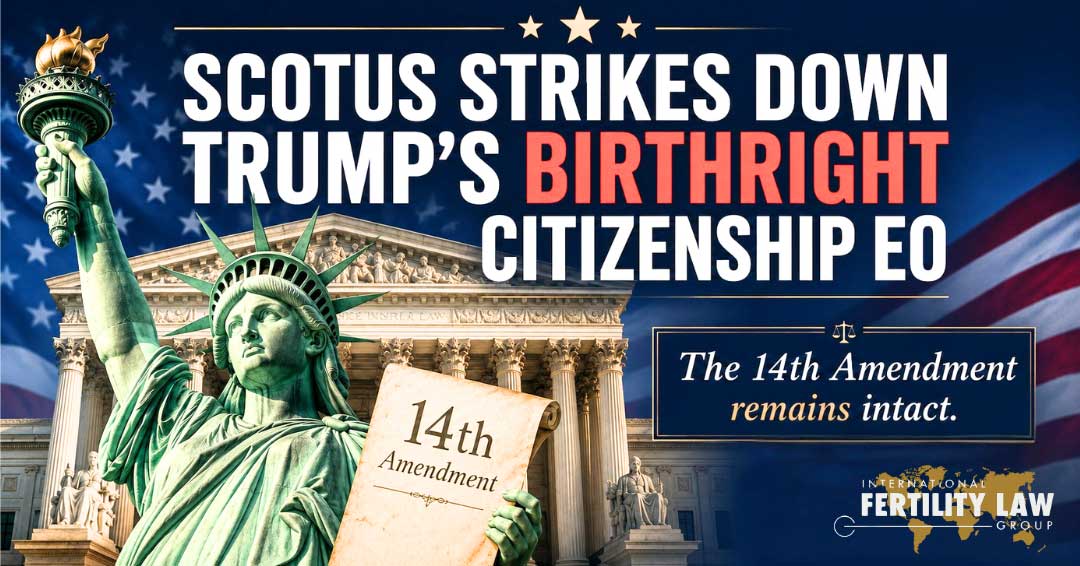
Scotus Upholds Birthright Citizenship and Strikes Down Trump’s Executive Order
The Supreme Court upheld birthright citizenship and ruled against Trump's Executive Order 14160, reaffirming Fourteenth Amendment protections.
Judge Joseph LaPlante of the U.S. District Court in New Hampshire certified a class action lawsuit covering all children born in the United States on or after February 20 who would be affected by the executive order and issued a preliminary injunction blocking its enforcement. This includes children born to undocumented parents, asylum seekers, and families present on student or work visas.
On June 27, 2025, the U.S. Supreme Court issued a decision that, while procedural in nature, has sparked understandable questions from international intended parents pursuing surrogacy in the United States. Chief among them: Will my child still be recognized as a U.S. citizen? This post is intended to offer clarity.
Trump v. CASA, Inc., et al. What does the Supreme Court's June 27, 2025 ruling mean for birthright citizenship? The short answer: It's still unfolding.The Court's decision on June 27, 2025, did not address the guarantee of citizenship for those born on U.S. soil enshrined in the 14th Amendment to the US Constitution since the 1800s. However, it did narrow the power of federal courts to issue nationwide (i.e., universal) injunctions.
If you have not requested an expedited birth certificate, it may take several weeks before your child’s birth certificate is available. Generally a written or online request is required for you to receive your child’s birth certificate, along with confirmation that you are an “authorized” person. You can order the certificate via an online service such as vitalchek.com or directly from the County Clerk or Recorder in the county where your baby was born. We strongly suggest you purchase multiple copies of your child’s birth certificate—particularly if you do not reside in the US or will need to request an amended birth certificate in future. The office will charge a per-copy fee.
Once the birth certificate worksheet is completed, the hospital birth clerk will send it to the vital records office in the county in which your child was born.
In the case of an expedited birth certificate request, ask the hospital birth clerk for the address of the local vital records office, where you will pick up the birth certificate in person. Call before you go to confirm the birth certificate is ready and available for you to pick up.
If you need an expedited birth certificate, as you might if you plan to take your baby home to another country, ask the hospital birth clerk to expedite the birth certificate request at this time. In most cases, you will receive the expedited birth certificate within a few days.
Following your baby’s birth, the hospital birth clerk will complete a birth certificate and birth registration worksheet.
Some states require that the birth registration documents include some information about the surrogate for public health and statistical purposes only, but such information will appear only on the confidential portion of the birth registration; however, the official birth certificate will not contain this information.
If your baby is born in a “pre-birth state,” where pre-birth orders of parentage are permitted for babies born via surrogacy, the birth clerk will use information from the pre-birth parentage judgment we obtain on your behalf. The parentage judgment will direct the registrar to allow you to name the child, as well as list you as the parent(s).
In states where pre-birth parentage orders are not allowed, the process is essentially the same except the birth clerk will eventually use information from the post-birth order we obtain on your behalf. In some instances, the birth clerk will need to send the birth registration to vital records before the post-birth order is obtained; and in these situations, the state’s Vital Records will enter the correct birth registration to show you as the legal parent(s).