What Is a Pre-Birth Order in Surrogacy Law?
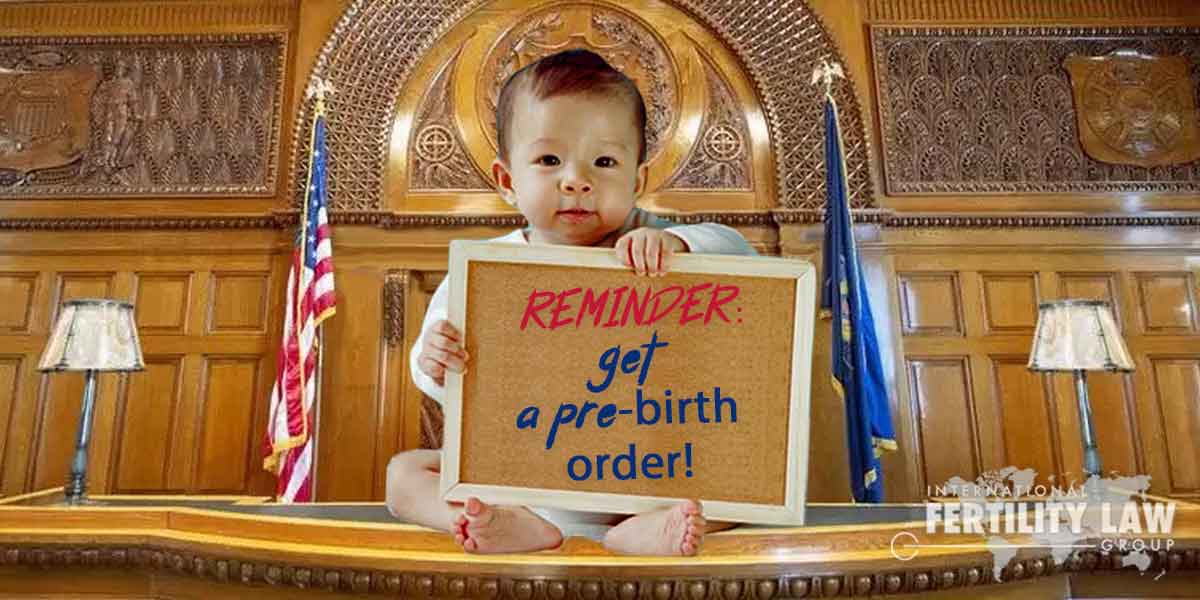
A “pre-birth order” in surrogacy law is used to establish the legal parentage of a child born via surrogacy and is preferred by many intended parents. However, several U.S. states…
Among the many challenges intended parents are facing during the coronavirus COVID-19 pandemic is the difficulty in obtaining newborn passports enabling them to take their babies born via surrogacy in…
In advance of his January 8 state-of-the-state address, Governor Andrew Cuomo has promised to renew his efforts to end New York’s statewide surrogacy ban in 2020 and to provide the…
After 19 years of court battles and legal ups and downs, the French Court of Final Appeal has recognized Sylvie and Dominique Mennesson as the legal parents of their twin…
For more than two years, we’ve been following the case of two Italian dads, a gay couple, who became parents of twin boys via egg donation and surrogacy in Canada,…
Congratulations to Washington State, which just became the first state to enact UPA 2017, the updated Uniform Parentage Act for use by U.S. states as uniform legislation for parentage laws,…
The headlines have been full recently of the stories of two same-sex couples, one parents of twins, the other parents of sibling daughters, both suing the U.S. State Department in…
In the wake of the June 26 ruling by the European Court of Human Rights on two French cases, the Spanish ministries of Justice and Foreign Affairs are ordering their consulates to reinstate registrations of children born via surrogacy to Spanish intended parents in countries where surrogacy is legal.
Earlier this month, in a ruling that rocked the worlds of same-sex couples and attorneys alike, a Brooklyn court denied the non-biological mother of a child born to a married lesbian couple the right to legally adopt her child.
The Gartner family of Iowa received wonderful news on May 3rd when they were notified that the Iowa Supreme Court agreed with them that the Department of Health must include the nonbiological mother of the couple’s daughter on the birth certificate.
In a landmark case, the genetic mother of twins born to a surrogate triumphed over the Irish government, winning the right to be listed as the mother on the birth certificates of her children.
The Child-Parent Security Act is in committee in the New York State legislature. The bill, introduced last May by Assemblywoman Amy Paulin (D-88th), would legalize surrogacy in the state.
If you have not requested an expedited birth certificate, it may take several weeks before your child’s birth certificate is available. Generally a written or online request is required for you to receive your child’s birth certificate, along with confirmation that you are an “authorized” person. You can order the certificate via an online service such as vitalchek.com or directly from the County Clerk or Recorder in the county where your baby was born. We strongly suggest you purchase multiple copies of your child’s birth certificate—particularly if you do not reside in the US or will need to request an amended birth certificate in future. The office will charge a per-copy fee.
Once the birth certificate worksheet is completed, the hospital birth clerk will send it to the vital records office in the county in which your child was born.
In the case of an expedited birth certificate request, ask the hospital birth clerk for the address of the local vital records office, where you will pick up the birth certificate in person. Call before you go to confirm the birth certificate is ready and available for you to pick up.
If you need an expedited birth certificate, as you might if you plan to take your baby home to another country, ask the hospital birth clerk to expedite the birth certificate request at this time. In most cases, you will receive the expedited birth certificate within a few days.
Following your baby’s birth, the hospital birth clerk will complete a birth certificate and birth registration worksheet.
Some states require that the birth registration documents include some information about the surrogate for public health and statistical purposes only, but such information will appear only on the confidential portion of the birth registration; however, the official birth certificate will not contain this information.
If your baby is born in a “pre-birth state,” where pre-birth orders of parentage are permitted for babies born via surrogacy, the birth clerk will use information from the pre-birth parentage judgment we obtain on your behalf. The parentage judgment will direct the registrar to allow you to name the child, as well as list you as the parent(s).
In states where pre-birth parentage orders are not allowed, the process is essentially the same except the birth clerk will eventually use information from the post-birth order we obtain on your behalf. In some instances, the birth clerk will need to send the birth registration to vital records before the post-birth order is obtained; and in these situations, the state’s Vital Records will enter the correct birth registration to show you as the legal parent(s).