
Proposed new law would provide paid leave for IVF loss
A proposed law now before Congress would guarantee parents who undergo failure of fertility treatments such as in vitro fertilization (IVF) or surrogacy, as well as those who lose babies…
Growing obstacles to intercountry adoption have drastically reduced the number of children adopted by U.S. residents from other countries—making assisted reproduction an increasingly appealing alternative for many seeking to fulfill…
The U.S. Supreme Court this week reversed an earlier ruling of the Alabama Supreme Court, reinstating the parental rights of a lesbian mom to the children she had legally adopted…
The Texas Department of State Health Services made headlines last month when it revealed in a court filing that it would begin allowing same-sex parents’ names on children’s birth certificates—although…
I traveled to New York this week to attend the American Fertility Association’s annual fundraising gala, Illuminations NYC, held Monday, Nov. 3, at The Yale Club of New York. This…
In the wake of the June 26 ruling by the European Court of Human Rights on two French cases, the Spanish ministries of Justice and Foreign Affairs are ordering their consulates to reinstate registrations of children born via surrogacy to Spanish intended parents in countries where surrogacy is legal.
U.S. district court broke down another barrier to same-sex marriage in a crucial ruling for same-sex parents in Ohio who have out-of-state adoption degrees.
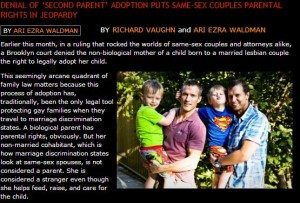
Earlier this month, in a ruling that rocked the worlds of same-sex couples and attorneys alike, a Brooklyn court denied the non-biological mother of a child born to a married lesbian couple the right to legally adopt her child.
Growing Generations, surrogacy and egg donation agency, was featured recently in an article in DuJour Magazine about the growing numbers of single men choosing to become parents via surrogacy.
Honorees at the upcoming American Fertility Association New York Illuminations November 4 are Nia Vardalos, recipient of the 2013 Carol Berger Adoption Advocacy Award, and Dr. Alan S. Penzias, M.D. recipient of the Joyce M. Vargyas MD Visionary Award.
The U.S. Supreme Court ruled June 25 on a case related to the Indian Child Welfare Act (ICWA), which was enacted in the late 1970s primarily to protect against the involuntary removal by child welfare authorities of children from Indian families for placement in non-Indian homes. The court decision.
Uruguay became the second Latin American nation, following Argentina, to legalize same-sex marriage
Another development in France was the issuance of an order from the French Justice Minister Christiane Taubira that could have enormous impact on French families created via assisted reproductive technology.
France became the second nation in one month to take the first steps toward marriage equality. The “Marriage for All” bill spearheaded by President François Hollande’s Socialist party also grants the same right to all married couples to adopt children.
An estimated 6 million to 14 million children have a lesbian or gay parent. Egg donation, surrogacy and IVF play a major role in forming these modern families who may not have had the opportunity to have children otherwise.
Assisted Reproductive Technology (ART) has been used in the U.S. for over 30 years as a means for couples with fertility struggles to start a family. ART includes a variety of fertility treatments, such as in vitro fertilization (IVF).
The unanimous 3-0 decision deals a critical blow to Florida's 33-year-old law banning adoption by gay men and lesbians.
There are actually quite a few legislative proposals being debated all across the country relating to assisted reproduction at the moment which could eventually have dramatic consequences (positive and negative) for your ART journey.
ICWA to protect the best interests of Indian children and to promote the stability and security of Indian tribes and families by establishing specific standards that must be met before an Indian child may be removed from his or her family or placed in an adoptive or foster care placement.
General information on Same-Sex Relationships
Lesbians in the District no longer will need the written consent of their partners to adopt children born to their partners through artificial insemination, under a new law that took effect Saturday
If you have not requested an expedited birth certificate, it may take several weeks before your child’s birth certificate is available. Generally a written or online request is required for you to receive your child’s birth certificate, along with confirmation that you are an “authorized” person. You can order the certificate via an online service such as vitalchek.com or directly from the County Clerk or Recorder in the county where your baby was born. We strongly suggest you purchase multiple copies of your child’s birth certificate—particularly if you do not reside in the US or will need to request an amended birth certificate in future. The office will charge a per-copy fee.
Once the birth certificate worksheet is completed, the hospital birth clerk will send it to the vital records office in the county in which your child was born.
In the case of an expedited birth certificate request, ask the hospital birth clerk for the address of the local vital records office, where you will pick up the birth certificate in person. Call before you go to confirm the birth certificate is ready and available for you to pick up.
If you need an expedited birth certificate, as you might if you plan to take your baby home to another country, ask the hospital birth clerk to expedite the birth certificate request at this time. In most cases, you will receive the expedited birth certificate within a few days.
Following your baby’s birth, the hospital birth clerk will complete a birth certificate and birth registration worksheet.
Some states require that the birth registration documents include some information about the surrogate for public health and statistical purposes only, but such information will appear only on the confidential portion of the birth registration; however, the official birth certificate will not contain this information.
If your baby is born in a “pre-birth state,” where pre-birth orders of parentage are permitted for babies born via surrogacy, the birth clerk will use information from the pre-birth parentage judgment we obtain on your behalf. The parentage judgment will direct the registrar to allow you to name the child, as well as list you as the parent(s).
In states where pre-birth parentage orders are not allowed, the process is essentially the same except the birth clerk will eventually use information from the post-birth order we obtain on your behalf. In some instances, the birth clerk will need to send the birth registration to vital records before the post-birth order is obtained; and in these situations, the state’s Vital Records will enter the correct birth registration to show you as the legal parent(s).